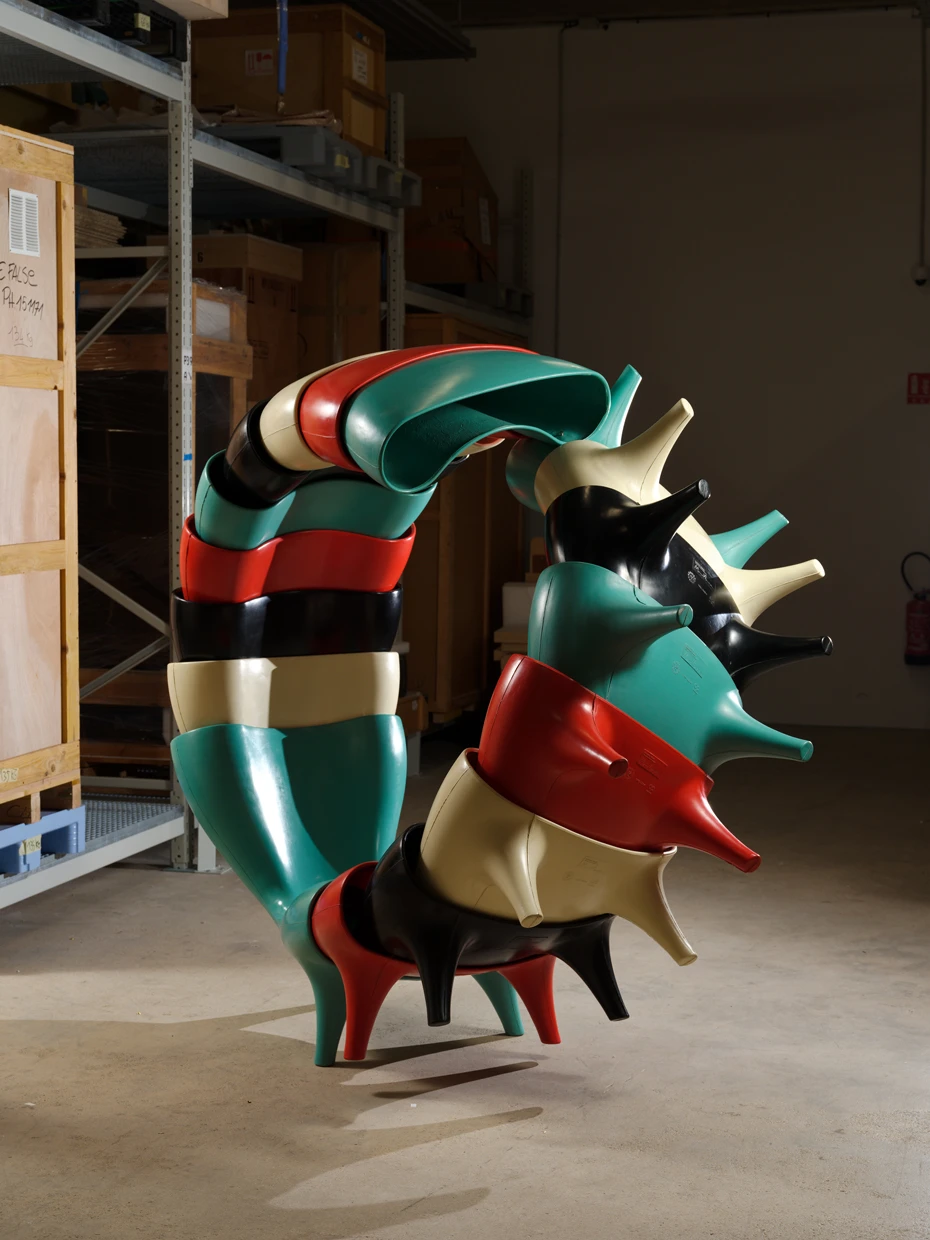
Exhibition at Le Plateau, Paris and at Les Réserves, Romainville
Opening : Saturday 14.02.26, from 2 pm
Curatorial team : Le Bureau/
With artworks by :
Béatrice Balcou, Jean-Luc Blanc, Camille Blatrix, Maurice Blaussyld, Michel Blazy, Pierre Bonnard, Étienne Bossut, Émilie Brout & Maxime Marion, Stéphanie Cherpin/Maria Corvocane, Nina Childress, Gaëlle Choisne, Jagna Cuichta, Bady Dalloul, Koenraad Dedobbeleer, Jason Dodge, Mimosa Echard et Christophe Lemaitre, Ryan Gander, Núria Güell, Ramin Haerizadeh, Rokni Haerizadeh et Hesam Rahmanian, My-Lan Hoang-Thuy, It’s Our Playground, Euridice Zaituna Kala, Marie Lund, Liz Magor, François Morellet, Pierre Paulin, Paola Siri Renard, Clément Rodzielski, Joe Scanlan, Charlotte Simonnet, John Smith, Batia Suter, Joëlle Tuerlinckx…
& an associated programme expanding beyond the museum into partner venues in Île-de-France
Curator: Rémi Enguehard, in collaboration with the public relations department of the Frac Île-de-France and the teams and curators of the partner venues
Le Syndrome de Bonnard (Bonnard Syndrome), exhibited at Le Plateau in Paris and Les Réserves in Romainville from 14th February to 19th July 2026, will reveal the evolving and open nature of the works. Through reworkings, reactivations and recycling, the works continue to evolve beyond their entry into the collections. Taking inspiration from the endless retouching of the painter Pierre Bonnard (1867–1947), the exhibition, curated by the collective Le Bureau/, brings together over thirty French and international artists to explore the impermanence of works, the malleability of narratives, and the ever-evolving dialogue between creation and institution.
It is said that Pierre Bonnard never stopped revisiting his paintings throughout his life. One anecdote in particular recounts how he was arrested by a security guard at the Musée du Luxembourg while attempting to surreptitiously retouch a tiny leaf in one of his paintings. In Practicalities (La Vie matérielle), Marguerite Duras recalls the story of a painting that Bonnard significantly altered without consulting the patrons who commissioned it. She reminds us that creativity rarely follows a straight path: ‘It happens in a book, at a turning point in a sentence: you change the subject of the book. (…) Paintings and writings are not created in complete clarity.’
These accounts bring together several legitimate perspectives: on the one hand, the institution that guarantees the conservation of the acquired work and its inclusion in a historical narrative as part of our heritage; on the other hand, the artist’s individual journey, which can involve significant shifts in their practice; and finally, the interpretation of the audience, which varies according to the era, geographical area, and so on.
Drawing on the Frac Île-de-France collection, Le Syndrome de Bonnard considers how artworks evolve after they have been acquired. Can the artist re-examine the trial and error of their studio practice once their work has been catalogued? How can certain works be constantly revisited, reactivated and updated? And what about the change in perception of a work in light of the evolution of our political, social, and environmental context? Ten years after staging its first exhibition devoted to these issues¹, Le Bureau/ is revisiting the theme and deepening its reflection on the impermanence of works of art at Le Plateau and Les Réserves.
From a contemporary perspective, ‘Bonnardism’ refers not only to an obsessive relationship to work or endless research, but also to the reorientations that occur within the ‘authorised narratives’² of the work: these include the diversifications of a practice, the wear and tear or transformation of materials, new interpretations that can be activated within the context of immaterial works, the evolution of the way works are viewed in relation to societal changes, and the continuous collaboration between artists and institutions regarding decisions such as whether to exhibit, restore or adapt works…
Spread across the Frac’s two sites, the exhibition showcases the unique features of each location:
- at Le Plateau in Paris, historically dedicated to production, it highlights artists’ trajectories and their relationship to time and society.
- at Les Réserves in Romainville, where the collection is preserved, it examines the materiality of the works and the institution’s responsibilities.
More than thirty pieces from the collection, created between 1977 and the present day, are presented alongside new works. Some offer the artist’s updated interpretation of a work sometimes acquired ten years earlier, while others offer a contemporary vision of ‘Bonnardism’. Finally, some pieces will evolve over the course of the exhibition, either according to a protocol established by the artists or due to their physical characteristics.
Le Syndrome de Bonnard encourages active engagement with the works in the collection, reconsidering their evolving and occasionally surprising material and conceptual dimensions. This openness becomes a central issue in how the works are received.
¹ Exhibition Le Syndrome de Bonnard, Villa du Parc, contemporary art centre, Annemasse, 2014, as part of the 20th anniversary celebrations of the Museum of Modern and Contemporary Art (MAMCO) in Geneva.
² Historian Jean-Marc Poinsot uses the term ‘authorised narratives’ to refer to all the narratives that accompany a work, from communication and mediation tools to publications and press coverage. Artists use these narratives as exhibition circumstances. See Jean-Marc Poinsot, Quand l’oeuvre a lieu. L’art exposé et ses récits autorisés, Les Presses du Réel/MAMCO, 2008).
Le Bureau/

Founded in 2004, Le Bureau/ is a collective that brings together members from different backgrounds and training, both theoritical and practica.l Over the past ten years, the collective has organised more than fifteen exhibitions in France and abroad.
From the outset, the collective’s structure has explicitly rejected the notion of a curator as the sole author of an exhibition. The idea is to produce an experimental approach to the exhibition form through collegial work and to consider the question of its reception through precise protocols, like the rules of a game. Additionally, the multiplicity of the curators’ points of view (emphasized by the ‘/’ in the collective’s name) highlights the polysemy of the works. This specific form of collaboration offers radical horizontality in the working process.
Today, Le Bureau/ brings together Marc Bembekoff, Garance Chabert, Aurélien Mole, Céline Poulin and Emilie Villez.